- Updated March 5, 2026
- Shefali Hardas
Cellular Jail Andaman and Nicobar Islands
[2026 Edition]


Book Tickets in Advance
Cellular Jail is one of the most popular attractions in Port Blair, especially known for its Light and Sound Show in the evening. Tickets can sell out quickly during peak season and holidays. It’s advisable to book your entry and show tickets at least a day or two in advance to avoid last-minute disappointment.

Book Tickets in Advance
Cellular Jail is one of the most popular attractions in Port Blair, especially known for its Light and Sound Show in the evening. Tickets can sell out quickly during peak season and holidays. It’s advisable to book your entry and show tickets at least a day or two in advance to avoid last-minute disappointment.
Cellular Jail Andaman and Nicobar Islands

Along the eastern coast of Indian Mainland, in the vast seas of Bay of Bengal rests a poignant relic of India’s fight for freedom – the infamous Cellular Jail of India. Tucked away on the secluded Andaman Islands, the Cellular Jail is a silent witness to the unwavering human spirit amidst adversity. If anything, the history of the Andaman and Nicobar Cellular Jail at Port Blair is a terrifying saga of years of torture and oppression. But what should’ve broken our heroes’ spirits, acted as a fuel and helped them keep going in the toughest of times.
The Making of the Cellular Jail

The idea of Cellular Jail, a penal confinement originated back in 1890 when Sir Charles James Lyall of Bengal Civil Service and Surgeon Major Alfred Swain Lethbridge, Inspector General of Jails, Bengal recommended that a closed, confined and concrete jail be constructed where one cell would hold only one prisoner, to solve the issues concerning security and health. The scheme was based on British and other European prison systems wherein physical and mental health were seen not to be affected severely.
Originally, the Jail was proposed to be made in the Viper Island but due to spatial constraints, two other sites in Port Blair were shortlisted. One was between Pahargaon and Protheroepur while the other site, which was ultimately approved, was at Atlanta Point in Aberdeen, 60 feet above the sea level.
Six years later, in October 1896, the construction of this dreary 7 winged, 600 celled prison began. Convicts were made to build their own cells. While some building material was brought from Burma and Andaman itself, lime was extracted by burning the corals from pristine coral reefs of these islands. The initial construction was completed in 1906 and the final one in 1909 where more cells were added.
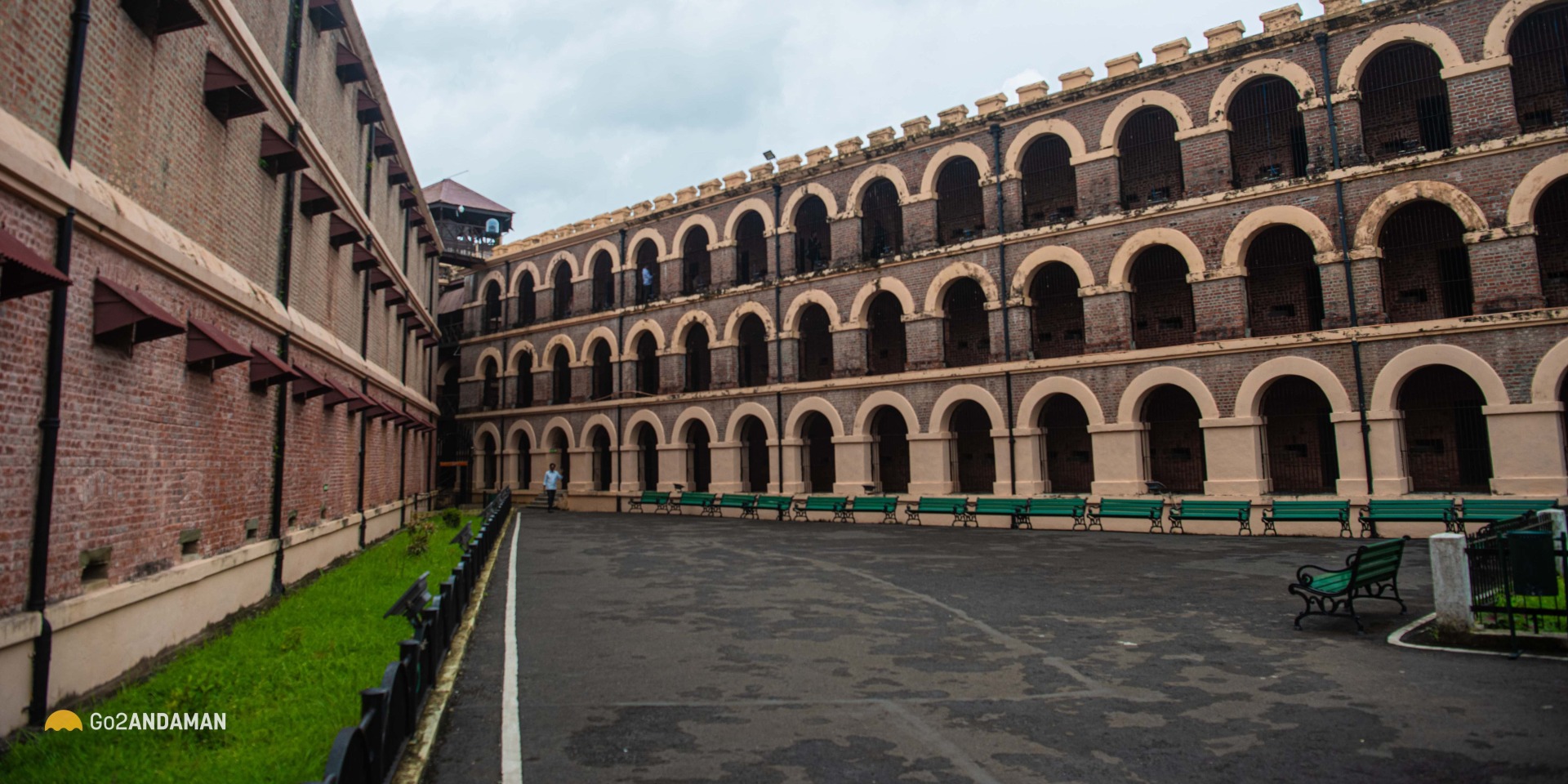
The structure had a central watchtower, 7 wings of unequal length, 3 storeys and 663 cells. The Jail was designed in a way that a lesser number of guards could keep a watch on a higher number of inmates. Each wing had cells placed in such a manner that the opening of one was greeted by the back of the other, hence, no inmates could maintain contact in any way.
The Gruesome Days of Cellular Jail

The Cellular Jail of Andaman and Nicobar Island housed various individuals who were deemed as threats to British colonial rule in India. Among them were political prisoners, activists, revolutionaries, and individuals who participated in movements against British rule. Post the Swadeshi movement and Partition of Bengal, more and more extremist groups emerged increasing violence. Revolutionary fervor surged in regions of Maharashtra, Bengal, Punjab, and various other provinces. Participants of the conspiracy cases, bombing cases, train dacoity cases, murder cases and even journalists and revolutionaries who used nonviolent means were deported to the Andamans from time to time.
The British saw Vinayak Damodar Savarkar (Veer Savarkar) as a high threat and sentenced him to 50 years of life imprisonment. He was an inspiration to the other inmates and their pillar strength. Bhatukeshwar Dutt, was brought here because of the historic bombing of the Central Legislative Assembly in Delhi alongside Bhagat Singh. Yogendra Shukla, Nani Gopal Mukherjee, Nand Kumar, Pulin Behari Das, and many more – all of them had their reasons but the goal was the same – Aazad Bharat.
Imprisonment at Cellular Jail in Port Blair, also known as Kaalapani ki Saza, really was kaalapani ki saza despite the bright blue waters of Andaman sea for the tortures were endless, inhumane and extreme. It was nothing lesser than terrifying and brutal. It was Hell on Earth. Various forms of torture, including strenuous manual labor, inadequate food, lack of medical assistance, verbal abuse, and physical beatings, were commonplace practices perpetrated by the jail authorities against the prisoners. The inmates were assigned to a range of tasks such as cane and bamboo work, operating coconut and mustard oil mills, husking coconuts, drying copra, crafting hooka shells, coir and sisal pounding, rope, carpet, and net weaving, towel making, mat production from coir and sisal hemp, mustard seed cleaning, blanket manufacturing, gardening, hill cutting, drain cleaning, swamp filling, and other miscellaneous chores. Despite many prisoners coming from educated Bhadralok families, they were often subjected to the harshest tasks like coir pounding, rope making, and oil grinding on the Kolhu.
Perhaps the desperation to be free was so strong and urgent that survival in such unimaginable conditions and the will to keep going was fuelled by every colonial move of the British. To even think of the life they lived is frightening. Even to this day, when you walk down the corridors of the cellular jail in Port Blair, when you stand in the cells where once the inmates cried themselves to the hope of seeing an end to this tortuous life, you feel the energy surrounding you
An End to the Black Terror

There were two major hunger strikes carried out in 1933 and 1937 by the revolutionaries in retaliation for the torture and inhumane behaviour of the British. But even during such times, the inmates were force fed insect infested food, contaminated water and undrinkable milk. The first hunger strike did not have a big impact but the second hunger strike saw the entire country acknowledging and joining hands to rally behind these freedom fighters regardless of not being present in the same place. The hunger strike was later called off but it was powerful enough to threaten the British.
Constant efforts of Mahatma Gandhi, Rabindranath Tagore and the others forced the colonial government to shut down and empty the jail. The campaign continued for two years and finally in 1939, the prisoners we repatriated. Over time, the Andaman and Nicobar Cellular Jail has endured significant damage inflicted by both natural forces and human intervention. The earthquake of 1941 and the invasion by Japanese forces resulted in considerable destruction to the structure.
Though the prisoners were moved, and the black terror came to an end, overcoming the trauma of the past was unexpectable. A life of oppression tainted the lives of the fighters and their families. Today, most residents of Andaman have at least one freedom fighter as their ancestor and on the one hand it is a matter of pride but on the other, the pain of hardships still lives after all these years.
A Pilgrimage of the Freedom Struggle

After the destruction of 4 wings of the Cellular Jail by the Earthquake and Tsunami, the government had decided to demolish the other 3 also but was immediately called off when former revolutionary prisoners of the Cellular Jail demanded that this symbol of tyranny needed to be preserved as a National Memorial to remind the future generations of the tremendous cost that was paid in Indian blood for the freedom of our country.
Hence today, Cellular Jail of India stands a national memorial in remembrance of those who laid their lives for the freedom struggle. It embodies aspirations and sacrifices of a nation striving for freedom and justice. The least we can do to pay our respects to the ones who fought long and hard is to know the history, their sufferings and the fact that unity has power to move even centuries of establishments.
People from around the world come to Andamans and make sure to visit the Jail, absorb its history and witness the cells, the watchtower, the hanging house, the grounds where the inmates were flogged and forced to work until they collapsed. There is an art gallery and a museum that showcases Cellular Jail photos and gives a detailed history of the events that occurred at this frightening Jail of Andamans. People visiting Andaman Islands also visit the “Paris of the East”, the Ross Island that was once the headquarters of the British here.
The Cellular Jail Light and Sound Show
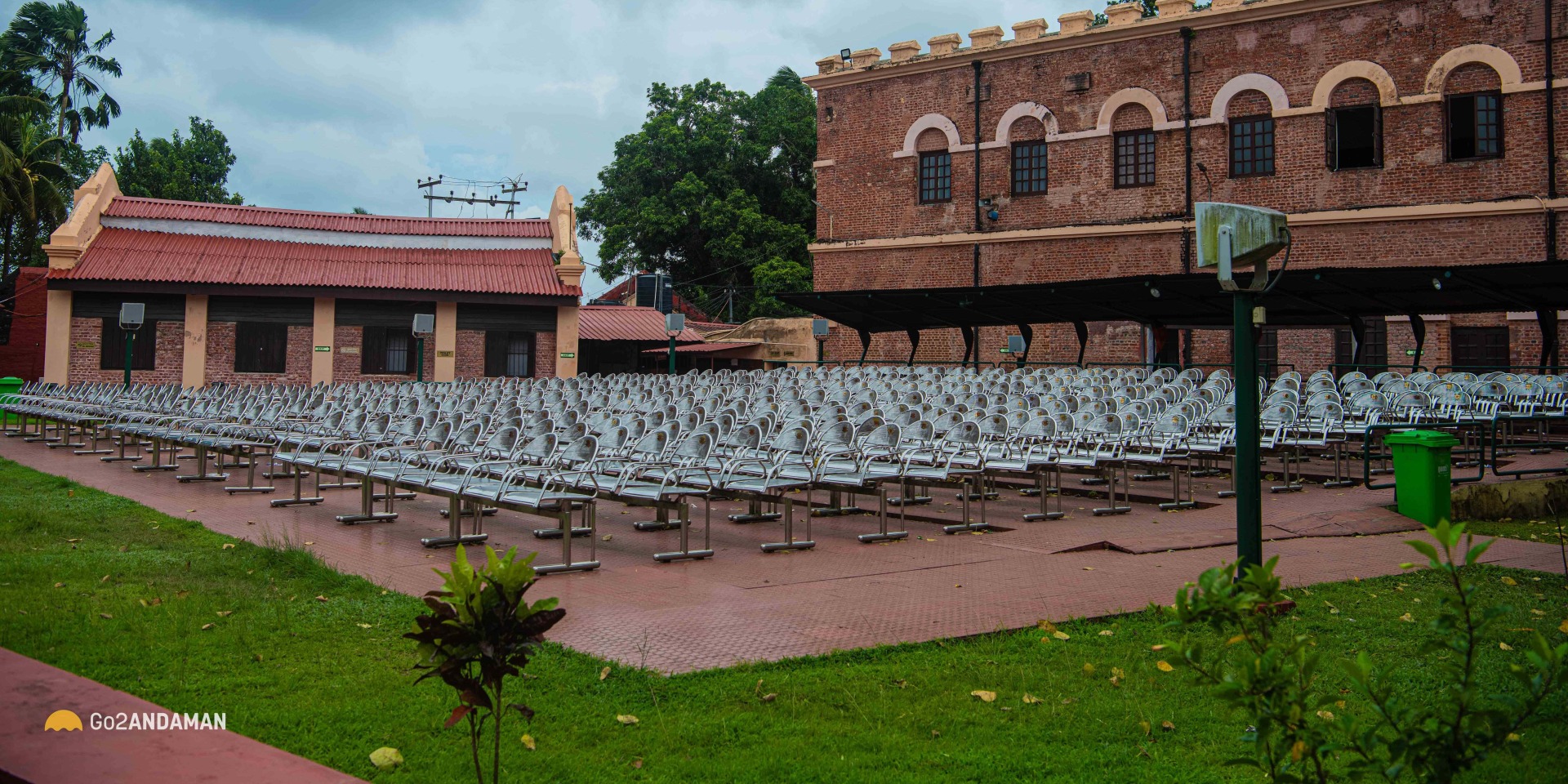
The Cellular Jail Light and Sound Show takes place in the evening against the backdrop of the imposing Cellular Jail. As darkness falls, the jail is illuminated with dramatic lighting effects, setting the stage for a captivating narrative that unfolds through a combination of lights, music, and narration.
Narrated in Hindi and English, the Cellular Jail Light and Sound Show provides insights into the lives of iconic freedom fighters who endured unimaginable hardships within the confines of Kaala Pani.
Cellular Jail stands as a symbol of hope and resilience, reminding visitors of the indomitable spirit of the human quest for freedom. The Cellular Jail Light and Sound Show is not only a tribute to the heroes of India’s independence movement but also a reminder of the enduring legacy of their struggle for justice and equality.
Frequently asked questions
How to reach Jolly Buoy from Port Blair?
You can take a cab from Port Blair to Wandoor Beach. From there, you can hop on a boat and get to Jolly Buoy.
Are there restaurants on the Island?
There are no eateries on the island. So, we recommend you to pack your picnic baskets with some snacks & food.
Should you pre- book boats to visit Jolly Buoy?
Yes, it is advisable to pre-book boats with a travel agency because the demand can be really high at times.
Is the island open throughout the year?
No, the island is only open for 6 months in a year.
Can you do snorkeling all by yourself in Jolly Buoy?
No, snorkeling by yourself is not allowed without the required permit.

Shefali Hardas
Other Guides

Want to go to the Andaman Islands? Read our travel guide for details about how to reach Port Blair and other islands of the Andamans. Get information on Port Blair’s best things to do, recommended places to visit, and hotels.

Planning a trip to Havelock Island? Our guide covers how to get there, the best beaches to visit, top water sports, and recommended places to stay for an unforgettable Andaman experience.

Visiting Neil Island? Check our travel guide for how to reach, must-visit beaches, top activities, and the best hotels to make the most of your laid-back island vacation.
Experiences in Port Blair
Nearby Attractions in Port Blair
Planning a trip to the Andaman?
We made this because we were tired of hearing “I wish I knew this earlier.” Ferries, permits, best stays, right beaches, everything you need, all in one place. Plan it yourself, just better.
Because it’s all about #moments that matter.
- Locally Verified
- Tried and tested
- Handpicked LISTINGS
- No sponsored picks