- Updated February 2, 2026
- Aswin
Birds of Andaman Island
[2026 EDITION]


Plan Ahead for Birdwatching in the Andaman Islands
The Andaman Islands are home to many unique and endemic bird species, making them a top destination for birdwatchers. However, some of the best birding spots—such as Chidiya Tapu, Saddle Peak, and Mount Harriet National Park—may require permits or are located in restricted areas. If you’re a first-time traveler, it’s a good idea to research access requirements and plan your visits in advance. Hiring a local guide can also improve your chances of spotting rare species and navigating forest trails safely.

Plan Ahead for Birdwatching in the Andaman Islands
The Andaman Islands are home to many unique and endemic bird species, making them a top destination for birdwatchers. However, some of the best birding spots—such as Chidiya Tapu, Saddle Peak, and Mount Harriet National Park—may require permits or are located in restricted areas. If you’re a first-time traveler, it’s a good idea to research access requirements and plan your visits in advance. Hiring a local guide can also improve your chances of spotting rare species and navigating forest trails safely.
Birds of Andaman Island
Did you know the Andaman Islands aren’t just your regular beach trip?
They offer a total recharge for your body and mind. Along the sandy shores and adventures, these islands are widely known as the Paradise of Birds. Yep, there are over 240 bird species, from migratory to exclusive Andaman birds, and more than 50 endemic bird species. Every year, these islands become a hotspot for all sorts of bird species, allowing travelers to enjoy bird photography and immerse themselves in a soulful experience.
Let’s explore prime bird-watching spots in the Andaman Islands and a look into the various species of birds native to the region.
Top Sites for Bird Watching in Andaman Island
Mount Harriet National Park, Chidiya Tapu, Sippighat, Cuthbert Wildlife Sanctuary, Shoal Bay, andHavelock Island are the ultimate destination for bird lovers in Andaman Island. These spots have all types of environments, from lush forests to chill coastal areas, where tons of different bird species live.
Whether you’re on a hike at Mount Harriet, or witnessing the sunset at Chidiya Tapu (literally translates to ‘bird island’), or just chilling by the peaceful beaches at Havelock Island, you’ll have a chance to find unique birds of Andaman at every spot. And you’ll get to see all kinds of birds, from the ones that live here all the time to the ones just passing through on their travels. So if you’re into birdwatching, definitely visit these spots in Andaman Island.
Unique Birds of Andaman Island
Andaman wood Piegeon

The Andaman wood pigeon (Columba palumboides) is a bird species found only in the Andaman and Nicobar Islands, India. Classified as the National Bird of Andaman and ‘near threatened’ by the IUCN, its population ranges from 2,500 to 10,000 mature individuals. It has a white head, black body, and red, yellow-tipped beak and claws. It is related to the green imperial pigeon and rock dove and is mostly found on North Passage Island.
Andaman Hawk Owl

The Andaman hawk owl is a type of owl that belongs to the Strigidae family and is found only in the Andaman Islands. This owl species usually lives in subtropical or tropical moist lowland forests and subtropical or tropical mangrove forests. Unfortunately, the Andaman hawk-owl population is decreasing due to the loss of its natural habitat. The owl has a compact body, and its face and upperparts are brownish. Note the bold, rust-colored streaks running down the underparts. The vent is usually white, and the tail has bars running across it and its significant yellow eyes makes it one of the most beautiful Birds of Andaman. Relatively shy, active outside daylight hours in well-wooded areas. The call is a distinctive low and resonant guttural “kroooo.”
Andaman Woodpecker

The Andaman woodpecker is a bird species belonging to the woodpecker family Picidae. It is native to the Andaman Islands in India and is found in tropical moist lowland forests. Sadly, it is threatened by habitat loss. The Andaman woodpecker is a large black bird with a red crest that is easily recognizable. It has a long, dark bill and strikingly pale eyes. This bird species is usually found in mangroves and evergreen forests, often in pairs or small groups. It is known to feed higher up in the trees but sometimes comes down to look for invertebrates. Its call is loud, sharp, and shrill and usually consists of one or two notes.
Andaman Teal

The Andaman teal is a type of duck that can only be found in the Andaman archipelago located in the Bay of Bengal. This species was previously considered to be a subspecies of the Sunda teal. It is a small brown duck with a pale throat and scalloped feathers. The face may be entirely white or have a white eye ring. During flight, a white panel can be seen on the upper wings as well as white armpits on the underwing. These ducks are sociable and can be seen gathering in marshy waterbodies. Go to Sippighat for finding this teal. You’ll find them nesting in tree holes.
Narcondam Hornbill

The Narcondam hornbill is the most beautiful among the birds of Andaman in the Bucerotidae family, found only on the Indian island of Narcondam in the Andamans. The bird is small with a black body, a white tail, and a pale bill with a flat, grooved casque on top. The males and females have different colors on their head and breast. The male has a rust-colored head and breast while the female’s head and breast are black. These Andaman birds have the smallest home range of all Asian hornbills. They feed on berries and fruits in tall trees. Their calls consist of short, wavering notes that have a somewhat nasal quality, as well as barks and grunts.
Andaman Serpent Eagle

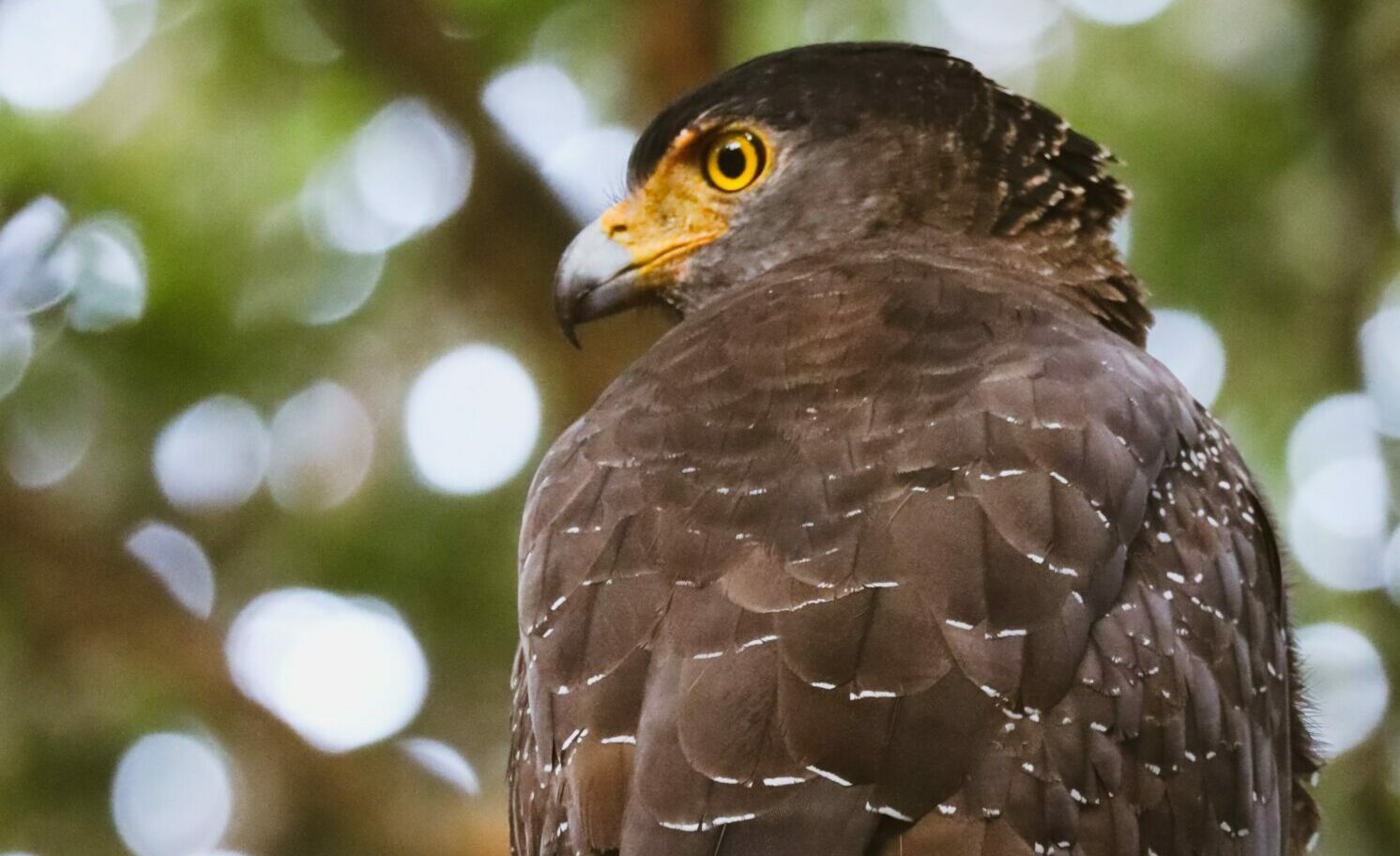
This Andaman Bird is a relatively small, uniformly dark brown eagle with a bright yellow bare patch between the eye and the bill that contrasts with the rest of its body. Its underparts have small white spots. When in flight, the wings display narrow black-and-white bands and the tail has thick black bands. The juvenile looks similar to the adult but with a pale, cream-colored head. This eagle is often seen perched in trees under the canopy, where it watches for small prey. Its calls consist of 4-5 short, chirp-like whistles.
Andaman Drongo

The Andaman drongo is a medium-sized bird with dark feathers, a strong bill, and a forked tail that curls outwards at the tips. It lives in forests and forest edges, where it searches for insects under the canopy. Drongos are often found in small groups and will flock with other species as well. They make a variety of calls, including tinkling sounds, metallic whistles, and short, harsh notes which makes it one the most melodiest Birds of Andaman.
Longtailed Parakeet

The long-tailed parakeet is a highly social bird that is often observed communicating with other birds of its kind. Though typically found in small groups, flocks of thousands of these birds have been spotted in the Andaman Islands and Borneo, particularly during the breeding season. The long-tailed parakeet is known for its colony breeding habits.
Andaman Treepie

The Andaman treepie belongs to the Corvidae family and is a slender, medium-sized dark bird with a long tail. Its face, wings, and tail are black, while the underparts and back are reddish-brown. You can identify it by the small white patch on its wings. These Andaman Birds are commonly found in well-wooded habitats, where it form small groups and hunt with other species. Its calls include a variety of metallic sounds, harsh screeches, dry trills, and soft whistles.
Andaman Flowerpecker

The Andaman flowerpecker belongs to the Dicaeidae family and is a small bird with a slim, dark, curved bill. Its upperparts are olive-green, while the pale underparts have a yellow smudge on the belly. These Andaman birds flit around restlessly in treetops, seeking fruits and flowers, and are usually found alone or in pairs. Although it is difficult to locate it in the canopy which makes it rare to see among other Birds of Andaman, its buzzy single-noted calls often give away its presence.
Frequently asked questions
What are the best months for birdwatching in the Andaman Islands?
October to April is ideal, especially November to February, when the weather is pleasant and both endemic and migratory birds are active.
Are there endemic bird species I can only see in the Andamans?
Yes! Look for species like the Andaman Woodpecker, Andaman Serpent Eagle, Andaman Drongo, and Andaman Crake—all found only here.
Is Chidiya Tapu worth visiting for serious birders?
Yes. Despite being close to Port Blair and touristy, early mornings at Chidiya Tapu can be excellent for spotting Andaman Coucal, collared kingfishers, and even Andaman Hawk-Owls.
Are drones or photography gear allowed in forest areas?
Drones are prohibited in protected areas. Photography is allowed, but some parks may charge an additional fee for cameras. Always check with the Forest Office before entering.
Is birdwatching safe in terms of wild animals or insects?
Generally, yes. But mosquitoes, sandflies, and occasional snakes in forested areas are a concern. Carry repellent, wear boots, and stay on marked trails.

Aswin
Other Guides

Want to go to the Andaman Islands? Read our travel guide for details about how to reach Port Blair and other islands of the Andamans. Get information on Port Blair’s best things to do, recommended places to visit, and hotels.

Planning a trip to Havelock Island? Our guide covers how to get there, the best beaches to visit, top water sports, and recommended places to stay for an unforgettable Andaman experience.

Visiting Neil Island? Check our travel guide for how to reach, must-visit beaches, top activities, and the best hotels to make the most of your laid-back island vacation.
Other Experiences in Andaman
Planning a trip to the Andaman?
We made this because we were tired of hearing “I wish I knew this earlier.” Ferries, permits, best stays, right beaches, everything you need, all in one place. Plan it yourself, just better.
Because it’s all about #moments that matter.
- Locally Verified
- Tried and tested
- Handpicked LISTINGS
- No sponsored picks